Places
The History of Yokosuka, the Naval Port That Made Curry Japanese
A coastal city an hour south of Tokyo, on a peninsula guarding the entrance to the bay. Its dockyards built the modern Japanese navy, and the food that navy ate on board became the most-eaten dish in the country.
The harbour
Why the Navy Chose This Stretch of Coast
Yokosuka sits on the Miura Peninsula in Kanagawa Prefecture, on the western side of the entrance to Tokyo Bay. The geography is the whole reason it exists as it does: deep water close to shore, hills at its back, and a position from which anything sailing towards the capital has to pass. What is a commuter city today was chosen as a strategic gate.
The turning point was the shipyard. From the 1860s, in the last years of the Tokugawa government and then under the new Meiji state, an ironworks and dockyard were built here with French engineering help — among the first heavy industry in the country. It trained a generation of Japanese engineers, and it made Yokosuka the home port of the Imperial Japanese Navy rather than simply a base among several.
The dish
How a British Stew Reached a Japanese Galley
Curry did not arrive in Japan from India. It arrived from Britain, in the late nineteenth century, as an Anglo-Indian stew thickened with a flour-and-butter roux — the form the Royal Navy fed its crews. The Imperial Japanese Navy was modelled closely on the Royal Navy, uniforms and rank structure and mess arrangements included, and the food travelled with the template.
It also suited the ship. A curry thickened with roux is a single-pot meal that tolerates rough weather, keeps its heat, uses cheap cuts and stretches to feed a crew, and it was combined with rice into a dish that could be issued from one galley. The naval diet of the period was under scrutiny for other reasons as well: beriberi was devastating crews on polished-rice rations, and the shift towards barley, wheat flour and mixed Western dishes was part of the response.
The document
A Recipe Book From 1908
The reason Yokosuka can claim curry so specifically is a book. In 1908 the navy issued a cookery manual for its galleys, and among the recipes in it is a curried stew of beef, potato, carrot and onion, thickened with flour and served with rice. It is not a legend passed down; it is a printed instruction to naval cooks, and it is close enough to what is eaten today to be recognisable.
From there the dish left the navy and did not stay a naval dish. Sailors on leave and after discharge took it home; it entered school lunches, canteens, department-store dining rooms and then, in the 1960s, the supermarket in the form of solid roux blocks. What began as a way to feed a crew became the household staple that Japanese people now eat more often than sushi.
To scale
Five Dates, Spaced as They Fell
1905 and 1908 sit almost on top of each other because they are three years apart. Spreading them out for tidiness would misrepresent the only thing a timeline is for.
Fridays
The Tradition That Outlasted the Empire
The Japan Maritime Self-Defense Force still eats curry on Fridays. The habit is usually explained as a way of keeping track of the week on long deployments, where the days otherwise run together, and it has become an institution rather than a menu decision — ships compete over their recipes, and crews are identified with them.
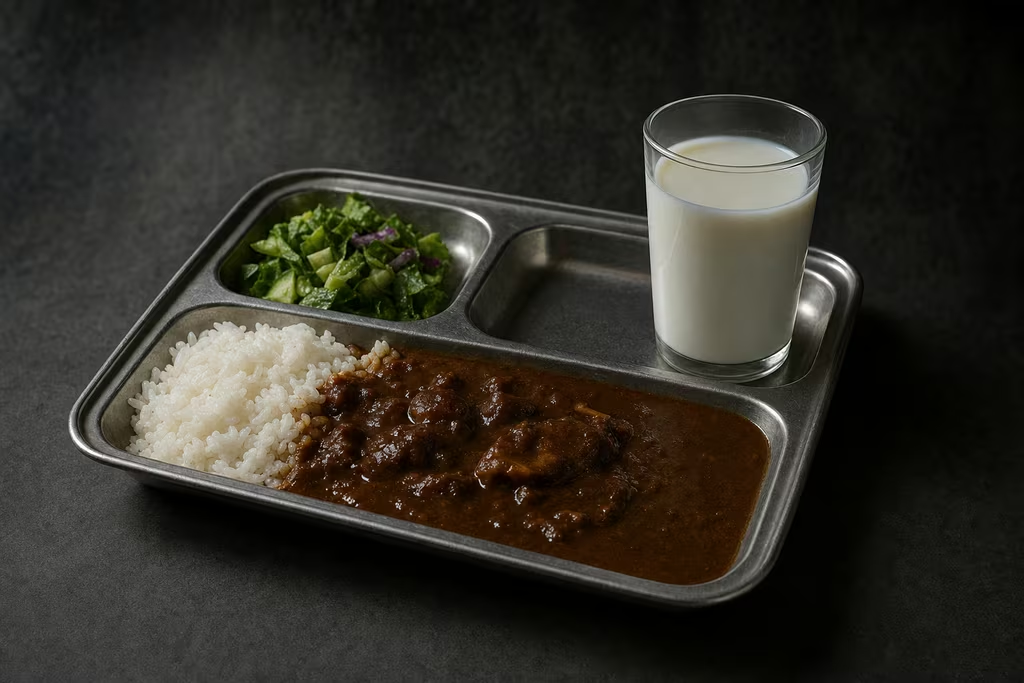
Ashore, the same tradition is what a visitor to Yokosuka encounters. The waterfront and the streets around the base carry curry restaurants, many of them working to the certified recipe, and the dish is served the way the scheme requires: with milk and a small salad alongside. Both of those are part of the original naval meal rather than modern additions.
The port now
What Is Still There to See
Yokosuka is still a working naval port, shared between the Japan Maritime Self-Defense Force and the United States Seventh Fleet, and much of the waterfront is closed accordingly. What is open is unusually direct about its own history. The battleship Mikasa, Admiral Tōgō’s flagship at Tsushima in 1905, sits preserved in concrete at the eastern end of the harbour, a short walk from the base it operated out of.
The curry is treated as heritage rather than as nostalgia. The city registered Yokosuka Naval Curry as a local speciality in the late 1990s, published the standard that restaurants have to meet to use the name, and built a street of licensed places serving it near the station. The dish those kitchens send out is deliberately closer to the 1908 galley version than to a modern Japanese curry house — flour-thickened, mild, served with milk and a salad, and recognisably the same recipe the navy wrote down.
Still asked
Questions About Yokosuka
Where is Yokosuka?
On the Miura Peninsula in Kanagawa Prefecture, on the west side of the entrance to Tokyo Bay, roughly an hour from central Tokyo by train.
Why is Yokosuka called the birthplace of Japanese curry?
Because the dish entered Japan through the Imperial Japanese Navy, whose home port and shipyard were here, and because the recipe survives in the navy’s own 1908 cookery manual. The city has promoted the claim formally since 1999.
Did curry really come from Britain rather than India?
The Japanese form did. What arrived was the Anglo-Indian curry of the Royal Navy, thickened with a flour-and-butter roux — a British adaptation. Japanese curry is closer to a stew than to anything cooked in India.
Is the naval base open to visitors?
Parts of the waterfront are accessible and harbour tours run past the moored ships, but the installations themselves are working military bases and are not generally open. Access and opening arrangements change, so they are worth checking before travelling.
Why do Japanese naval crews eat curry on Fridays?
As a way of marking the week at sea, where one day is otherwise much like another. It began as a practical habit and survived as a tradition, to the point where individual ships are known for their own versions.
Read next
The Dish Itself, and the Other Thing Tsuru Was Known For
Dishes
Everything About Japanese Curry
A stew rather than a curry: roux blocks, katsu, and a certification scheme.
Roux, not spice paste
Condiments
Homemade Chilli Oil Recipe: The Crunchy Kind
The sediment is the product, and two oil temperatures decide whether it works.
Eat the solids