Chapter 03 · The slice
Cutting Salmon for Nigiri: Why the Angle Matters More Than the Fish
A good loin badly cut makes a worse piece than an ordinary loin cut well. Almost everything a diner reads as quality — the shine, the edge, the way the slice holds its shape — is decided by the knife, not by the fish.
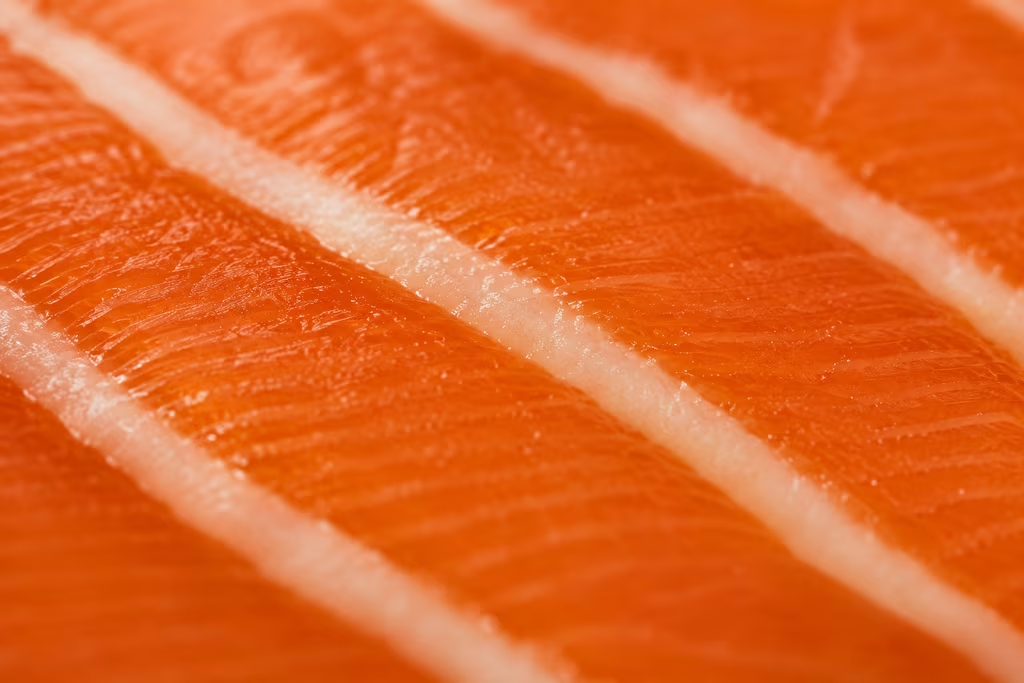
The grain
Across the Muscle, Never Along It
Salmon flesh is built in segments separated by sheets of connective tissue, the white bands visible on any slice. Those sheets are the reason a slice holds together, and the reason it can fall apart: cut across them and each band crosses the piece like a tie, holding the flesh; cut along them and the same bands run the length of the slice and let it split under its own weight over the rice.
This is why the loin is squared off before anything is sliced. Trimming establishes which way the grain runs and gives the blade a flat face to work from, so every subsequent cut arrives at the same angle relative to the muscle rather than to the outside of the fish.
The angle
Shallow Enough to Widen the Face
The blade goes in at a shallow angle rather than straight down. A slanted cut produces a wider face from the same thickness of flesh, which matters because the slice has to cover the rice base without being thinned to the point where it tears. The technique has a name, sogizukuri, and it is the default for anything soft enough to lose its shape.
Thickness sits around eight to ten millimetres for salmon — thicker than tuna would be given, because the flesh is softer and a thin slice slumps rather than draping. The pair of decisions works together: a shallow angle at a generous thickness gives a wide, structurally sound face, and either one on its own gives a slice that is too small or too fragile.
The geometry
The Same Thickness, Twice the Face
Same loin, same slice thickness, two blade angles. The claim in the paragraph above is geometric, and geometry is the one thing a drawing does better than a sentence.
The stroke
One Draw of the Blade, Not a Saw
The cut is finished in a single pull. A yanagiba is ground on one side only and is long enough to complete a slice without a second pass, which is the entire purpose of that shape — every extra stroke tears the surface it has already cut, and torn flesh scatters light instead of reflecting it. The difference is visible across a counter: a single-stroke slice looks wet, a sawn one looks dull.
Sharpness does the work that force would otherwise do. A blade that has to be pushed compresses the flesh ahead of it and leaves a face that has been crushed as much as cut, which is also why a serrated knife is the wrong tool no matter how sharp it feels on bread.
The loin
The Same Fish Gives Different Slices
Fat content varies along a fillet, so where the knife entered changes what arrives. The belly runs richer and softer, the loin nearer the tail is leaner and firmer and takes a cleaner edge, and the back is somewhere between the two. None of these is better; they are different slices, and a counter cutting to order chooses between them rather than working through the fish in order.
Farmed Atlantic salmon makes this visible more than most species, because its fat is both abundant and unevenly distributed. It is also why a piece of salmon nigiri from the same fish can read as buttery one day and clean the next without anything having changed in the method.
The tools
Why the Knife Is That Long
The knife used for this is a yanagiba: single-bevelled, ground flat on one side, and roughly 270 to 300mm long. Every part of that description follows from the stroke. A single bevel steers the cut away from the flat face, so the slice comes off with one clean surface rather than two slightly crushed ones. The length exists so the whole slice can be taken in one pull without the heel of the blade ever entering the fish, because a second stroke is what leaves the ragged edge.
The rest of the setup serves the same end. The blade is wiped between slices, since a film of fat on steel drags rather than cuts. The board is kept barely damp, so the loin does not stick and get pulled out of shape as the knife passes. The fish itself is worked cold and firm, because a slack piece deforms under the blade and produces a slice that looks thicker at one end than the other. None of this is ceremony; each of them removes one way for the slice to come out wrong.
Still asked
Questions About Cutting Salmon
How thick should salmon be cut for nigiri?
Around eight to ten millimetres, at a shallow angle. Salmon is softer than tuna, so a slice taken too thin loses its shape over the rice, and one taken too thick stops being a single mouthful.
Which way is across the grain on a salmon loin?
Perpendicular to the white bands running through the flesh. Those bands are the connective tissue between muscle segments; crossing them holds a slice together, following them lets it split.
Do you need a Japanese knife?
You need a knife long enough to finish a slice in one pull and sharp enough not to be pushed. A yanagiba is ground for exactly that, but any thin, very sharp, long blade will cut a clean face. A serrated edge will not.
Why does the fish look dull instead of glossy?
Usually a sawn cut. Each extra pass of the blade tears the surface already cut, and a torn surface scatters light. A single stroke leaves a face flat enough to reflect it.
Should the salmon be frozen first?
For raw service, freezing to the temperatures and durations set by local food-safety rules is the standard parasite control, and it is what "sashimi grade" refers to in practice. Handling after that matters as much: it is thawed under refrigeration and cut before it warms past room temperature.
Read next
What the Slice Is Laid On, and What Goes Under It
The base
Sushi Rice Is Made First, and It Decides the Rest
Seasoned hot, held warm, pressed once — and the failure that cannot be undone.
Twenty minutes before the fish
The seasoning
Real Wasabi vs the Green Paste
Why it is hidden underneath, and how to tell which one you are served.
A dab you never see
The bill
Why Is Sushi So Expensive?
The same farmed Atlantic salmon, priced as a service rather than as seafood.
Labour, rent and VAT